
Crossing the Rubicon 3/4
The third part of the fifth tale from Heroes of History
It was shown abundantly, on many occasions in the course of Caesar’s life, that he had no faith in omens. There are equally numerous instances to show that he was always ready to avail himself of the popular belief in them to awaken his soldiers’ ardor or to allay their fears.
Whether, therefore, in respect to this story of the shepherd trumpeter it was an incident that really and accidentally occurred, or whether Caesar planned and arranged it himself with reference to its effect, or whether the tale was only an embellishment invented out of something or nothing by the storytellers of those days to give additional dramatic interest to the narrative of the crossing of the Rubicon, it must be left for each reader to decide.
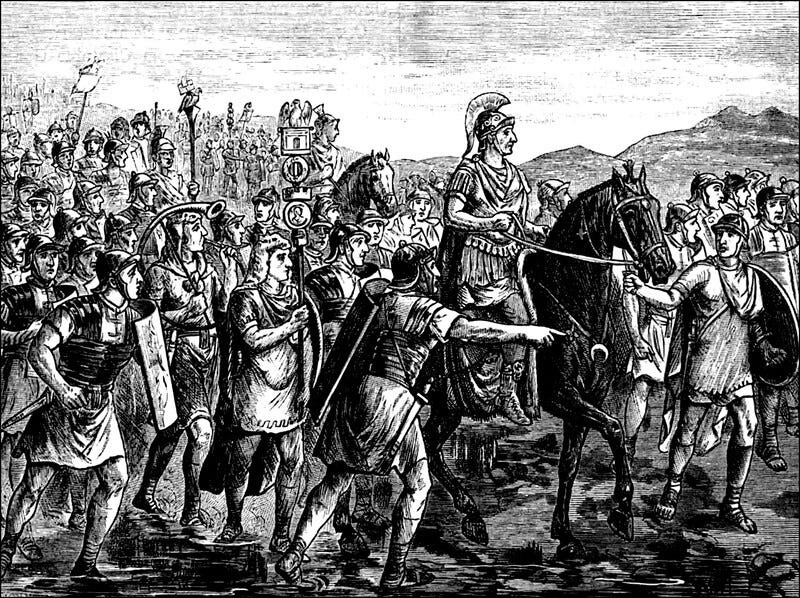
As soon as the bridge was crossed, Caesar called an assembly of his troops and with signs of great excitement and agitation made an address to them on the magnitude of the crisis through which they were passing. He showed them how entirely he was in their power; he urged them, by the most eloquent appeals, to stand by him, faithful and true, promising them the most ample rewards when he should have attained the object at which he aimed. The soldiers responded to this appeal with promises of the most unwavering fidelity.
The first town on the Roman side of the Rubicon was Ariminum. Caesar advanced to this town. The authorities opened its gates to him—very willing, as it appeared, to receive him as their commander. Caesar’s force was yet quite small, as he had been accompanied by only a single legion in crossing the river. He had, however, sent orders for the other legions, which had been left in Gaul, to join him without any delay—though any reinforcement of his troops seemed hardly necessary, as he found no indications of opposition to his progress.
He gave his soldiers the strictest injunctions to do no injury to any property, public or private, as they advanced and not to assume in any respect a hostile attitude toward the people of the country. The inhabitants, therefore, welcomed him wherever he came, and all the cities and towns followed the example of Ariminum, surrendering faster than he could take possession of them.
In the confusion of the debates and votes in the Senate at Rome before Caesar crossed the Rubicon, one decree had been passed deposing him from his command of the army and appointing a successor. The name of the general thus appointed was Domitius. The only real opposition which Caesar encountered in his progress toward Rome was from him. Domitius had crossed the Apennines at the head of an army on his way northward to supersede Caesar in his command and had reached the town of Corfinium, which was perhaps one-third of the way between Rome and the Rubicon. Caesar advanced upon him here and shut him in.
After a brief siege, the city was taken, and Domitius and his army were made prisoners. Everybody gave them up for lost, expecting that Caesar would wreak terrible vengeance upon them. Instead of this, he received the troops at once into his own service and let Domitius go free.
In the meantime, the tidings of Caesar’s having passed the Rubicon, and of the triumphant success which he was meeting with at the commencement of his march toward Rome, reached the capital and added greatly to the prevailing consternation. The reports of the magnitude of his force and of the rapidity of his progress were greatly exaggerated. The party of Pompey and the Senate had done everything to spread among the people the terror of Caesar’s name in order to arouse them to efforts for opposing his designs, and now, when he had broken through the barriers which had been intended to restrain him and was advancing toward the city in an unchecked and triumphant career, they were overwhelmed with dismay.
Pompey began to be terrified at the danger which was impending. The Senate held meetings without the city—councils of war, as it were, in which they looked to Pompey in vain for protection from the danger which he had brought upon them. He had said that he could raise an army sufficient to cope with Caesar at any time by stamping with his foot. They told him they thought now that it was high time for him to stamp.
In fact, Pompey found the current setting everywhere strongly against him. Some recommended that commissioners should be sent to Caesar to make proposals for peace. The leading men, however, knowing that any peace made with him under such circumstances would be their own ruin, resisted and defeated the proposal. Cato abruptly left the city and proceeded to Sicily, which had been assigned him as his province. Others fled in other directions.
Pompey himself, uncertain what to do and not daring to remain, called upon all his partisans to join him and set off at night, suddenly, and with very little preparation and small supplies, to retreat across the country toward the shores of the Adriatic Sea. His destination was Brundusium, the usual port of embarkation for Macedon and Greece.
Caesar was all this time gradually advancing toward Rome. His soldiers were full of enthusiasm in his cause. As his connection with the government at home was sundered the moment he crossed the Rubicon, all supplies of money and of provisions were cut off in that quarter until he should arrive at the capital and take possession of it. The soldiers voted, however, that they would serve him without pay. The officers, too, assembled together and tendered him the aid of their contributions. He had always observed a very generous policy in his dealings with them, and he was now greatly gratified at receiving their requital of it.
The further he advanced, the more he found the people of the country through which he passed disposed to espouse his cause. They were struck with his generosity in releasing Domitius. It is true that it was a very sagacious policy that prompted him to release him. But it was generosity, too. In fact, there must be something of a generous spirit in the soul to enable a man even to see the policy of generous actions.
The End, Part Three