
Joan of Arc 10/13
The tenth part of the thirteenth tale from Heroes of History
Her family was made noble; on their shield, between two lilies, a sword upholds the crown. Her father was at Reims and saw her in her glory. What reward, then, was Joan to choose? She chose nothing for herself, only that her native village of Domremy should be free from taxes. This news her father carried home from the splendid scene at Reims.
As they went from Reims after the coronation, Dunois and the archbishop were riding by her rein. The people cheered and shouted with joy.
“They are a good people,” said Joan. “Never saw I any more joyous at the coming of their king. Ah, would that I might be so happy when I end my days as to be buried here!”
Said the archbishop, “Oh, Joan, in what place do you hope to die?”
Then she said, “Where it pleases God; for I know not that hour nor that place more than you do. But would to God, my maker, that now I might depart, and lay down my arms, and help my father and mother, and keep their sheep with my brothers and my sister, who would rejoice to see me.”
What was to be done after the crowning of the king? Bedford, the regent for the child Henry VI, expected to see Joan under the walls of Paris. He was waiting for the troops which the Cardinal of Winchester had collected in England. Bedford induced Winchester to bring his men to France, but they had not arrived. The Duke of Burgundy, the head of the great French party which opposed Charles, had been invited by the Maid to Reims.
Again she wrote to him, “Make a firm, good peace with the King of France,” she said. “Forgive each other with kind hearts. I pray and implore you, with joined hands, fight not against France.”
The Duke of Burgundy, far from listening to Joan’s prayer, left Paris and went to raise men for the English. Meanwhile, Charles was going from town to town, and all received him gladly. But Joan soon began to see that instead of marching west from Reims to Paris, the army was being led southwest toward the Loire. There the king would be safe among his dear castles, where he could live indoors and take his ease.
Thus Bedford was able to throw 5,000 men of Winchester’s into Paris, and he even dared to come out and hunt for the French king. The French should have struck at Paris at once as Joan desired. The delays were excused because the Duke of Burgundy had promised to surrender Paris in a fortnight. But this he did merely to gain time. Joan knew this and said there would be no peace but at the lance-point.
The French and English armies kept watching each other, and there were skirmishes near Senlis. On August 15, the Maid and d’Alencon hoped for a battle. But the English had fortified their position in the night with ditches, palisades, and a laager of wagons. Come out they would not, so Joan rode up to their fortification, standard in hand, struck the palisade and challenged them to sally forth. She even offered to let them march out and draw themselves up in line of battle. The Maid stayed on the field all night, and the next day she made a retreat, hoping to draw the English out of their fort. But they were too wary and went back to Paris.
Now the fortnight was over, after which the Duke of Burgundy was to surrender Paris, but he did nothing of the kind. The Maid was weary of words. She called the Duc d’Alencon and said, “My fair duke, array your men, for by my staff, I would fain see Paris more closely than I have seen it yet.”
On August 23, Joan and d’Alencon left the king at Compiegne and rode to St. Denis, where were the tombs of the kings of France. The king was afraid to go near Paris, but Bedford was afraid to stay in the town. He went to Rouen, the strongest English hold in Normandy, leaving the Burgundian army and 2,000 English in Paris.
Every day, the Maid and d’Alencon rode from St. Denis to the gates of Paris to observe the best places for an attack. And still Charles dallied and delayed; still the main army did not come up. Thus the delay of the king gave the English time to make Paris almost impregnable and to frighten the people who, had Charles marched straight from Reims, would have yielded as Reims did.
D’Alencon kept going to Senlis, urging Charles to come up with the main army. He went on September 1st; the king promised to start next day. D’Alencon returned, yet the king still loitered. At last d’Alencon brought him to St. Denis on September 7, and there was a skirmish that day.
In the book of Perceval de Cagny, who was with his lord, the Duc d’Alencon, he says:
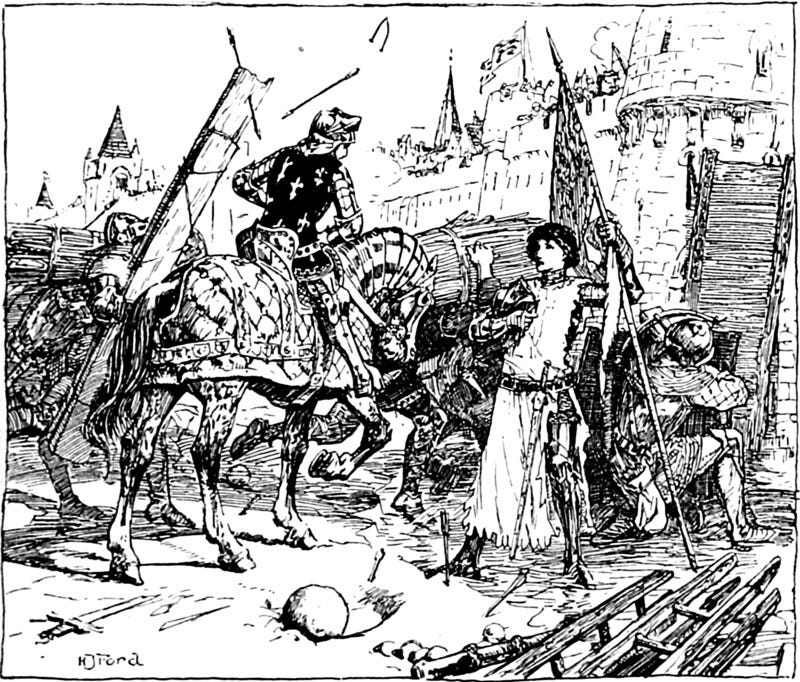
The assault was long and fierce, and it was a marvel to hear the noise of the cannons and culverins from the walls and to see the clouds of arrows. Few of those in the fosse with the Maid were struck, though many others on horse and foot were wounded with arrows and stone cannon balls, but by God’s grace and the Maid’s good fortune, there was none of them but could return to camp unhelped.
The assault lasted from noon till dusk—say eight in the evening. After sunset, the Maid was struck by a crossbow bolt in the thigh, and after she was hurt, she cried but the louder that all should attack, that the place was taken. But as night had now fallen and she was wounded, and the men-at-arms were weary with the long attack, De Gaucourt and others came and found her, and against her will brought her forth from the fosse. And so ended that onslaught.
The End, Part Ten