
Joan of Arc 3/13
The third part of the thirteenth tale from Heroes of History
Again, Joan was not only healthy but wonderfully strong, ready, and nimble. In all her converse with princes and priests and warriors, she spoke and acted like one born in their own rank. It is impossible, then, to say that she was mad.
Mad folk hear voices; starved nuns, living always with their thoughts bent on Heaven, women of feeble body, accustomed to faints and to fits, have heard voices and seen visions. Some of them have been very good women; none have been strong, good riders, skilled in arms, able to march all day long with little food, able to draw the arrow from their own wound and mount horse and charge again, like Joan of Arc.
In one respect, Joan’s conduct after these Voices and visions began was perhaps, as regarded herself, unfortunate. She did not speak of them to her parents, nor tell about them to the priest when she confessed. Her enemies were thus able to say, later, that they could not have been holy visions or Voices; otherwise she would not have concealed them from her father, her mother, and the priest, to whom she was bound to tell everything and from whom she should have sought advice.
Thus, long afterward, St. Theresa had visions, and in obedience to her priest, she at first distrusted these as perhaps a delusion of evil or a temptation of spiritual pride. Joan, however, was afraid that her father would interfere with her mission and prevent her from going to the king. She believed that she must not be “disobedient to the heavenly vision.”
In 1428 only a very few small towns in the east still held out for the Dauphin, and these were surrounded on every side by enemies. Meanwhile the Voices came more frequently, urging Joan to go into France and help her country. She asked how she, a girl, who could not ride or use sword and lance, could be of any help? Rather would she stay at home and spin beside her dear mother.
At the same time she was encouraged by one of the vague old prophecies which were common in France. A legend ran that France was to be saved by a Maiden from the Oak Wood, and there was an Oak Wood near Domremy. Some such prophecy had an influence on Joan and probably helped people to believe in her. The Voices often commanded her to go to Vaucouleurs, a neighboring town which was loyal, and there meet Robert de Baudricourt, who was captain of the French garrison.
Now, Robert de Baudricourt was not what is called a romantic person. Though little over thirty, he had already married two rich widows. He was a gallant soldier, but a plain practical man, very careful of his own interest and cunning enough to hold his own among his many enemies, English, Burgundian, and Lorrainers.
Joan had a cousin who was married to one Durand Lassois, at Burey en Vaux, a village near Vaucouleurs. This cousin invited Joan to visit her for a week. At the end of that time she spoke to her cousin’s husband. There was an old saying, as we saw, that France would be rescued by a Maid, and she, as she told Lassois, was that Maid. Lassois listened, and, whatever he may have thought of her chances, he led her to Robert de Baudricourt.
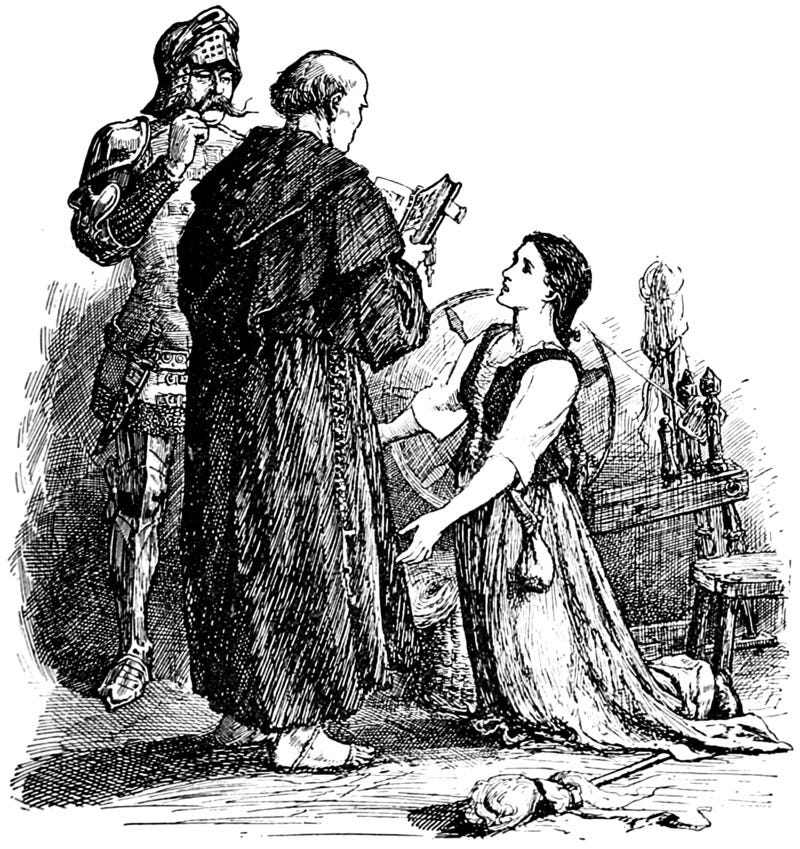
Joan came, in her simple red dress, and walked straight up to the captain among his men. She knew him, she said, by what her Voices had told her. She told him that the Dauphin must keep quiet and risk no battle, for before the middle of Lent next year, God would send him succor. She added that the kingdom belonged not to the Dauphin but to her Master, who willed that the Dauphin should be crowned, and she herself would lead him to Reims to be anointed with the holy oil.
“And who is your Master?” said Robert.
“The King of Heaven!”
Robert, very naturally, thought that Joan was crazed, and he shrugged his shoulders. He bluntly told Lassois to box her ears and take her back to her father. So she had to go home; but here new troubles awaited her. The enemy came down on Domremy and burned it; Joan and her family fled to Neufchateau, where they stayed for a few days.
When Joan looked from her father’s garden to the church, she saw nothing but a heap of smoking ruins. These things only made her feel more deeply the sorrows of her country. The time was drawing near when she had prophesied that the Dauphin was to receive help from Heaven—namely, in the Lent of 1429. On that year the season was held more than commonly sacred, for Good Friday and the Annunciation fell on the same day.
So, early in January, Joan turned her back on Domremy, which she was never to see again. Her cousin Lassois came and asked leave for Joan to visit him again; so she said goodbye to her father and mother and to her friends. She went to her cousin’s house at Burey, and there she stayed for six weeks, hearing bad news of the siege of Orleans by the English.
Meanwhile, Robert de Baudricourt, in Vaucouleurs, was not easy in his mind, for he was likely to lose the protection of Rene of Anjou, the Duc de Bar, who was on the point of joining the English. Thus Robert may have been more inclined to listen to Joan than when he bade her cousin box her ears and take her back to her father.
A squire named Jean de Nouillompont met Joan one day. “Well, my lass,” said he, “is our king to be driven from France, and are we all to become English?”
“I have come here,” said Joan, “to bid Robert de Baudricourt lead me to the king, but he will not listen to me. And yet to the king I must go, even if I walk my legs down to the knees, for none in all the world—king, nor duke, nor the King of Scotland’s daughter—can save France but myself only. Certainly, I would rather stay and spin with my poor mother, for to fight is not my calling, but I must go, and I must fight, for so my Lord will have it.”
“And who is your lord?” said Jean de Nouillompont.
“He is God,” said the Maiden.
“Then, so help me God, I shall take you to the king,” said Jean, putting her hands in his. “When do we start?”
“Today is better than tomorrow,” said the Maid.
The End, Part Three