
Joan of Arc 4/13
The fourth part of the thirteenth tale from Heroes of History
Joan was now staying in Vaucouleurs with Catherine le Royer. One day, as she and Catherine were sitting at their spinning-wheels, who should come in but Robert de Baudricourt with the cure of the town. Robert had fancied that perhaps Joan was a witch! He told the priest to perform some rite of the Church over her so that if she were a witch, she would be obliged to run away. But when the words were spoken, Joan threw herself at the knees of the priest, saying, “Sir, this is ill done of you, for you have heard my confession and know that I am not a witch.”
Robert was now half disposed to send her to the king and let her take her chance. But days dragged on, and when Joan was not working, she would be on her knees in the crypt or underground chapel of the Chapel Royal in Vaucouleurs. Twenty-seven years later a chorister boy told how he often saw her praying there for France. Now people began to hear of Joan, and the Duke of Lorraine asked her to visit him at Nancy, where she bade him lead a better life. He is said to have given her a horse and some money.
On February 12, the story goes, Joan of Arc went to Robert de Baudricourt. “You delay too long,” she said. “On this very day, at Orleans, the gentle Dauphin has lost a battle.”
This was, in fact, the Battle of Herrings, so called because the English defeated and cut off a French and Scottish force which attacked them as they were bringing herrings into camp for provisions in Lent.
Now the people of Vaucouleurs brought clothes for Joan to wear on her journey to the Dauphin. They were such clothes as men wear—doublet, hose, surcoat, boots, and spurs—and Robert de Baudricourt gave Joan a sword. Her reason was that she would have to be living alone among men-at-arms for a ten days’ journey, and she thought it was more modest to wear armor like the rest. Also, her favorite saint, St. Margaret, had done this once when in danger. Besides, in all the romances of chivalry, we find fair maidens fighting in arms like men or traveling dressed as pages.
In the end this man’s dress, which henceforth she always wore, proved the ruin of Joan. Her enemies, the English and the false French, made it one of their chief charges against her that she dressed, as they chose to say, immodestly.
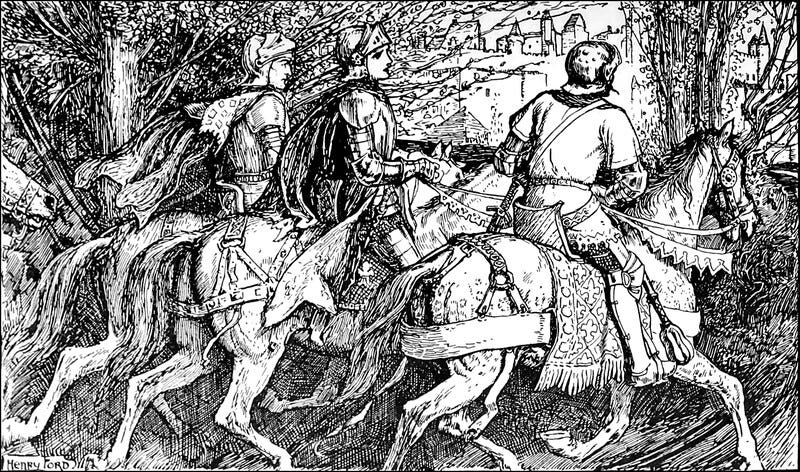
On February 23, 1429, the gate of the little castle of Vaucouleurs was thrown open. Seven travelers rode out, among them two squires, Jean de Nouillompont and Bertrand de Poulengy, with their attendants, and Joan the Maid.
“Go, and let what will come of it come!” said Robert de Baudricourt.
He did not expect much to come of it. It was a long journey—they were eleven days on the road—and a dangerous. But Joan laughed at danger. “God will clear my path to the king, for to this end I was born.”
Often they rode by night, stopping at monasteries when they could. Sometimes they slept out under the sky. Though she was so young and so beautiful, with the happiness of her long desire in her eyes, and the glory of her future shining on her, these two young gentlemen never dreamed of paying their court to her, as in romances they do, for they regarded her “as if she had been an angel.” They were in awe of her, they said long afterward, and all the knights who had seen her said the same. Dunois and d’Aulon and the Duc d’Alencon all said that she was “a thing enskied and sainted.”
From Fierbois, Joan of Arc made some clerk write to the king that she was coming to help him and that she would know him among all his men. Probably it was here that she wrote to beg her parents pardon, and they forgave her, she says. Meanwhile, news reached the people then besieged in Orleans that a marvelous Maiden was riding to their rescue.
On March 6, Joan arrived in Chinon, where for two or three days the king’s advisers would not let him see her. At last they yielded, and she went straight up to him, and when he denied that he was the king, she told him that she knew well who he was.
“There is the king,” said Charles, pointing to a richly dressed noble.
“No, fair Sire. You are he!”
Joan stayed at Chinon in the house of a noble lady. The young Duc d’Alencon was on her side from the first. Great people came to see her and question her, but when she was alone, she wept and prayed. The king sent messengers to inquire about her at Domremy, but time was going on, and Orleans was not relieved.
Joan was weary of being asked questions. One day she went to Charles and said, “Gentle Dauphin, why do you delay to believe me? I tell you that God has taken pity on you and your people at the prayer of St. Louis and St. Charlemagne. And I will tell you, by your leave, something which will show you that you should believe me.” Then she told him secretly something which, as he related, none could know but God and himself.
What did Joan say to the king, and what was the sign? About this her enemies later examined her ten times. She told them from the very first that she would never let them know—that if they made her speak, what she spoke would not be the truth. At last she told them a kind of parable about an angel and a crown, which neither was nor was meant to be taken as true. It was the king’s secret, and Joan kept it.
The End, Part Four