
Scrap 2/2
The second part of the thirty-fifth tale from The Animal Book
The regiment was tiresome with tales of his tricks. The height of his highest leap was registered in the mess, and the number of rats that had died in his teeth were an ever increasing score in the canteen. He was fairly aquiver with the mere excitement and curiosity of living.
There was no spot in the camp too secure or too sacred for Scrap to penetrate. His invasions were without impertinence, but the regiment was his, and he deposited dead rats in the lieutenant’s shoes as casually as he concealed bones in the French horn, and slumbered in the major’s hat box with the same equanimity with which he slept in Muldoon’s jacket.
The major evicted Scrap violently, but being a good-natured man, said nothing to the colonel, who was not. But it happened, only a day after the episode of the hat box, that the colonel entered his quarters to find the yellow mascot, fresh from a plunge in the surf and a roll in the dirt, reposing on his overcoat.
To say that the colonel was angry would be weak, but overwhelmed as he was, he managed to find words and deeds. Scrap fled with a sharp yelp as a boot tree caught him just above the tail.
His exit did not fail to attract attention in the company street. The men were uneasy, for the colonel was noticeably a man of action as well as of temper. Their premonitions were fulfilled when at assembly the next morning an official announcement was read to the attentive regiment.
The colonel, who was a strategist as well as a fighter, had considered the matter more calmly overnight. He was annoyed by the multiplicity of Scrap’s appearances at times and places where he was officially a nuisance. He was more than annoyed by the local paper’s recent reference to “our crack yellow-dog regiment.” But he knew the strength of regimental sentiment concerning Scrap and the military superstition of the mascot, and he did not want to harrow the feelings of the “summer camp” by detailing a firing squad. Therefore he left a loophole for Scrap’s escape alive. The announcement read, “All dogs found in camp not wearing collars will be shot, by order of the commanding officer.”
Now there were but two dogs in camp, and the colonel’s wore a collar. The regiment heard the order with consternation.
“That’ll fix it,” said the colonel, comfortably.
“Suppose someone gets a collar?” suggested the major, with a hint of hopefulness in his voice.
“I know my regiment,” said the colonel. “There isn’t enough money in it three days before pay day to buy a button. They’ll send him out tonight.”
Immediately after drill, there was a council of war in Muldoon’s tent, Muldoon holding Scrap between his knees. Scrap’s scratched ear, which habitually stood cocked, flopped forlornly; his stump tail drooped dismally. The atmosphere of anxiety oppressed his sensitive spirit. He desired to play, and Muldoon only sat and rolled his argumentative tongue.
From this conference, those who had been present went about the business of the day with a preternatural gloom that gradually permeated the regiment. The business of the day was varied, since the next day was to be a field day, with a review in the morning and cavalry maneuvers in the afternoon.
All day Scrap was conspicuous in every quarter of the camp, but at suppertime the lieutenant of Company A noted his absence from his habitual place at the left of Muldoon in the men’s mess tent. The lieutenant was annoyed by his own anxiety.
“Of course they’ll get him out, sir?” he said to the major.
“Of course,” the major assented, with more confidence than he felt. The colonel was fairly irritable in his uncertainty over it.
Next morning the sentries, who had been most strictly enjoined to vigilant observation, reported that no one had left camp that night, though a man on beat four must have failed in an extraordinary way to see a private crossing his line six feet in front of him.
The muster failed to produce any rag-eared, stub-tailed, eager-eyed, collarless yellow cub. Nor did the mess call raise his shrill bark in the vicinity of the cook’s tent. The lieutenant felt disappointed.
He thought that the regiment should at least have made some sort of demonstration in Scrap’s defense. It seemed a poor return for such confidence and loyalty to be hustled out of the way on an official threat.
It seemed to him the regiment was infernally light-hearted as, pipeclay white and nickel bright in the morning sun, it swung out of camp for the parade ground, where the dogcarts and runabouts and automobiles were gathering from Del Monte and the cottages along the shore.
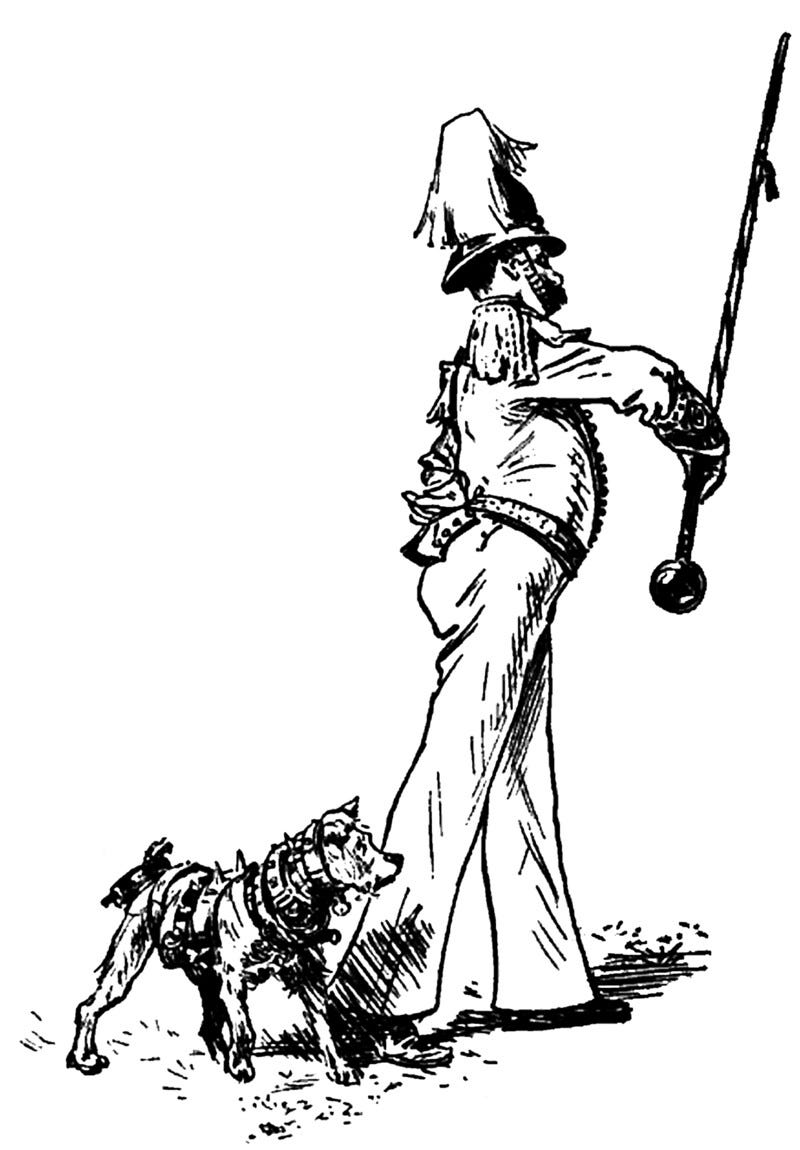
The sight of the twelve companies moving across the field with the step of one warmed the cockles of the colonel’s pride. The regiment came to parade rest, and the band went swinging past their front, past the reviewing stand. As it wheeled into place, the colonel, who had been speaking to the lieutenant of Company A, bit his sentence in the middle and glared at something that moved, glittering, at the heels of the drum-major.
The colonel turned bright red. His glass fell out of his eye-socket.
“What the devil is the matter with that dog?” he whispered softly. And the lieutenant, who had also seen and was suffocating, managed to articulate, “Collars!”
The colonel put his glass back in his eye. His shoulders shook. He coughed violently as he addressed the adjutant:
“Have that dog removed—no, let him alone—no, adjutant, bring him here!”
So the lieutenant, biting his lip, motioned Muldoon to fall out.
Tough old Muldoon tucked Scrap, struggling, squirming, glittering like a hardware shop, under his arm and saluted his commander while the review waited.
The colonel was blinking through his glass and trying not to grin.
“Sergeant, how many collars has that dog got on?”
“Thirteen, sor,” said Muldoon.
“What for?” said the colonel, severely.
“Wan for each company, sor, an’ wan for the band.”
The End