
The Gray Collie 1/3
The first part of the thirty-eighth tale from The Animal Book
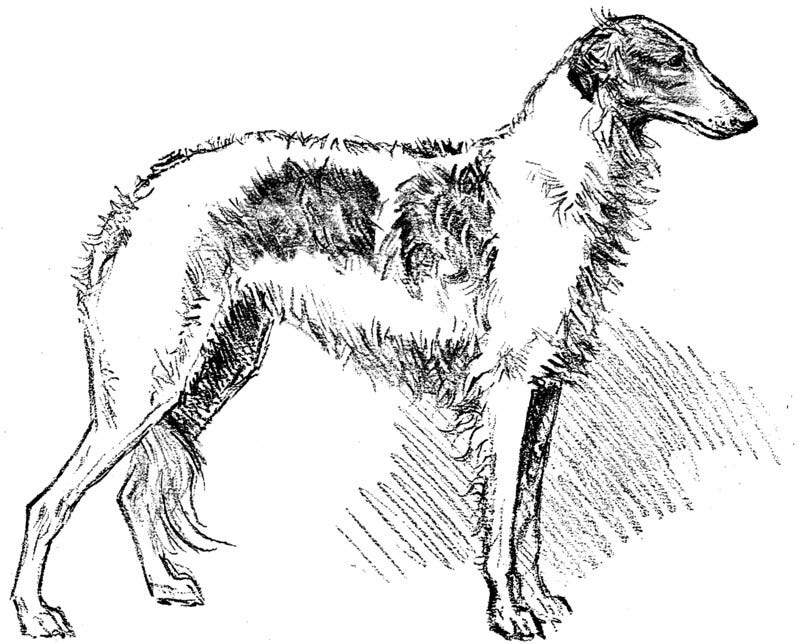
The steam had retired, clanking, from the radiator, withdrawing to the cellar like the dragging chain of Marley’s ghost. The blue flame of a Bunsen burner was the only light and heat left. Now and then the wind flung handfuls of spiteful sleet at the window.
“I don’t know anything about ghosts,” said Henrietta, plaintively. “I’m as bad in psychology as mathematics. I might tell about the gray collie, but he was real. Don’t let that chocolate boil over, Isabel.”
Isabel poured out three steaming cups, thick and sweet, for in the young twenties and late teens the appetite is still bizarre.
“I’ll tell it as it happened,” sighed Henrietta. “I don’t believe I could make anything up to save my neck.”
She was small and sad-eyed, with a timid manner, and she sat on a wolf skin, leaning one elbow on its head, which had green eyes of sinister slant and bristling ears.
“You know who Artaxerxes was?”
“Artaxerxes,” they recited, “was your old wolfhound who was really benevolent, but everybody was afraid of him, and when he wagged his tail, it waved like a cat’s, sinuously, instead of swinging in a clubby, careless way, as a dog’s should.”
“He was white with gray spots,” mused Henrietta, “I suppose his family in Siberia looked like that to match the snow when they went out hunting, and he was shaggy and soft.
“We chained him the night the circus came to town. He heard a lion roar as the train went by at three o’clock, and at first I thought we had another lion in the barn. Gracious! If he hadn’t been chained, he would have been over the wall and chased that lion to the station.
“I went down to soothe him and see if his chain had given in any of its links. I never saw him so out of temper. Finally, he consented to lie down, though he grumbled about it, and the tip of his tail kept twitching, not wagging. He hardly ever wagged it.
“We supposed he would stop worrying when the circus went, but instead he got worse. He explained how it was his business to find out what had become of all those animals. In the evenings, as soon as he was unchained, he would march up and down inside the wall, holding his nose to the wind and every now and then making a low impatient sound in his throat, as if he were worried about something and making plans.
“One morning Farmer Grosman came to our house, very fierce. ‘Your dog’s been killing my sheep.’ We explained that he never got over the six-foot wall, but nothing would do. If he hadn’t done it, who had? If we did not shoot him, he would, and so on.
“Papa was very polite. He said he regretted that he could allow no shooting on the place except what he did himself. ‘You are certainly entitled to shoot any dog or dogs which you may discover molesting your sheep, and I shall exercise the same prerogative in protecting my dog.’
“He said it with that deprecating smile of his—I believe he smiled deprecatingly when he got cut off from his men at Antietam and fought his way out of a lot of rebels who tried to make him prisoner. He hated Grosman, who was the meanest man in town and starved his horses.
“One morning Pete Lancto, who mows the lawn, said he had seen the devil and that he was like a shaggy dog.
“‘Probably it was a dog!’ I said. But he told a lot of lies about smelling brimstone and flames coming out of its eyes.
“I said, ‘I guess you were tight.’
“But he hadn’t touched a drop and had only been to get a new salt codfish at the store.
“‘Well, anyway, if it smelt of brimstone, it wasn’t Artie.’
“But that idiot said, ‘The devil, he can smell brimstone when he wants to—je pense que oui!’
“So I let him alone. You can’t argue with a man who hasn’t any premises to argue from.
“It was my work to go to the village for the mail. I went after supper, about sunset, or a little later.
“The road curves along the side of Mount Phelim, which is not much of a mountain but rather too big for a hill. When you look south, it is as if the trees stood on each others’ heads, and there are wide open spaces, like a park, so that you can see between the trunks, only by the road the underbrush is thick like a hedge. But on the north side of the road you don’t want to tumble off, for the Powasket runs below, hidden under the tops of trees, so that you only know it’s there from the sound. When I was little, I used to be afraid of that road because a Canuck nurse-girl had scared me with stories of bears and catamounts and Indians.
“But when I grew to like it at night, Papa began to object. A good many times when I’ve been sitting on the edge of the road swinging my feet over the Powasket, watching the last color going out beyond Canada and listening to the owls and frogs and things, he has come to meet me and grumbled about ‘going to extremes.’ But I had him, you see, and only laughed. Hadn’t he trained me to do it?’’
The End, Part One