
The Mare Lisette 1/3
The first part of the thirty-fourth tale from The Animal Book
General Marbot, one of Napoleon’s most distinguished soldiers, describes some of his adventures at the battle of Eylau.
A wealthy Frenchman had a large stud, in the first rank of which figured a lovely mare called Lisette, easy in her paces, as light as a deer, and so well broken that a child could lead her. But this mare, when she was ridden, had a terrible fault, and fortunately a rare one: she bit like a bulldog and furiously attacked people whom she disliked, which decided her owner to sell her.
The police ordered that a written statement should be placed in Lisette’s stall to inform purchasers of her ferocity, and that any bargain with regard to her should be void unless the purchaser declared in writing that his attention had been called to the notice. You may suppose that with such a character as this the mare was not easy to dispose of, and her owner had decided to let her go for what anyone would give. I offered 1,000 francs, and Lisette was delivered to me, though she had cost him 5,000.
This animal gave me a good deal of trouble for some months. It took four or five men to saddle her, and you could only bridle her by covering her eyes and fastening all four legs, but once you were on her back, you found her a really incomparable mount. However, since while in my possession she had already bitten several people and had not spared me, I was thinking of parting with her.
But I had meanwhile engaged in my service Francis Woirland, a man who was afraid of nothing, and he, before going near Lisette, armed himself with a good hot roast leg of mutton. When the animal flew at him to bite him, he held out the mutton. She seized it in her teeth and—burning her gums, palate, and tongue—gave a scream, let the mutton drop, and from that moment was perfectly submissive to Woirland and did not venture to attack him again. I employed the same method with a like result. Lisette became as docile as a dog and allowed me and my servant to approach her freely. She even became a little more tractable toward the stablemen of the staff, whom she saw every day, but woe to the strangers who passed near her!
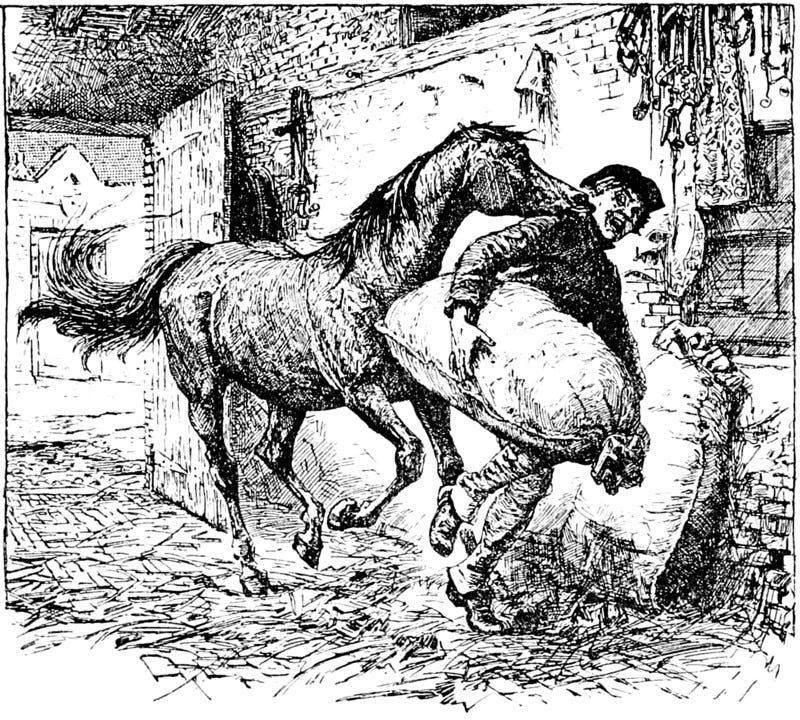
I could quote twenty instances of her ferocity, but I will confine myself to one. While Marshal Augereau was staying at the chateau of Bellevue, near Berlin, the servants of the staff, having observed that when they went to dinner someone stole the sacks of corn that were left in the stable, got Woirland to unfasten Lisette and leave her near the door.
The thief arrived, slipped into the stable, and was in the act of carrying off a sack when the mare seized him by the nape of the neck, dragged him into the middle of the yard, and trampled on him till she broke two of his ribs. At the shrieks of the thief people ran up, but Lisette would not let him go till my servant and I compelled her, for in her fury she would have flown at anyone else.
Such was the mare which I was riding at Eylau at the moment when the fragments of Augereau’s army corps, shattered by a hail of musketry and cannonballs, were trying to rally near the great cemetery. We could see how the intrepid regiment, surrounded by the enemy, was waving its eagle in the air to show that it still held its ground and asked for support.
The Emperor, touched by the grand devotion of these brave men, resolved to try to save them. He ordered Augereau to send an officer to them with orders to leave the hillock, form a small square, and make their way toward us, while a brigade of cavalry should march in their direction and assist their efforts.
It was customary in the Imperial army for the aides-de-camp to place themselves in file a few paces from their general, and for the one who was in front to go on duty first; then, when he had performed his mission, to return and place himself last, in order that each might carry orders in his turn, and dangers might be shared equally. It was my turn.
It was almost impossible to carry out the Emperor’s wishes, because a swarm of Cossacks was between us and the 14th, and it was clear that any officer who was sent toward the unfortunate regiment would be killed or captured before he could get to it. But the Emperor must be obeyed. I was a soldier. It was impossible to make one of my comrades go in my place, nor would I have allowed it; it would have been disgracing me. So I dashed off. But though ready to sacrifice my life, I felt bound to take all necessary precautions to save it.
I regarded myself as a horseman who is trying to win a steeplechase, who goes as quickly as possible and by the shortest line toward the appointed goal without troubling himself with what is to right or left of his path. Now, as my goal was the hillock occupied by the 14th, I resolved to get there without taking any notice of the Cossacks, whom in thought I abolished.
This plan answered perfectly. Lisette, lighter than a swallow, and flying rather than running, devoured the intervening space, leaping the piles of dead men and horses, the ditches, the broken gun carriages, the half-extinguished bivouac fires.
The End, Part One