
The Sea Otter 3/4
The third part of the thirtieth tale from The Animal Book
As the jaws of death gaped for the sea otter, with a writhe of her swift body she flashed to one side, while the little cub whimpered in her arms and the fatal teeth of the shark just grazed her trailing, flipper-like hind legs, so close they snapped behind her. Swerving beneath the great bulk, the otter began a desperate flight for life.
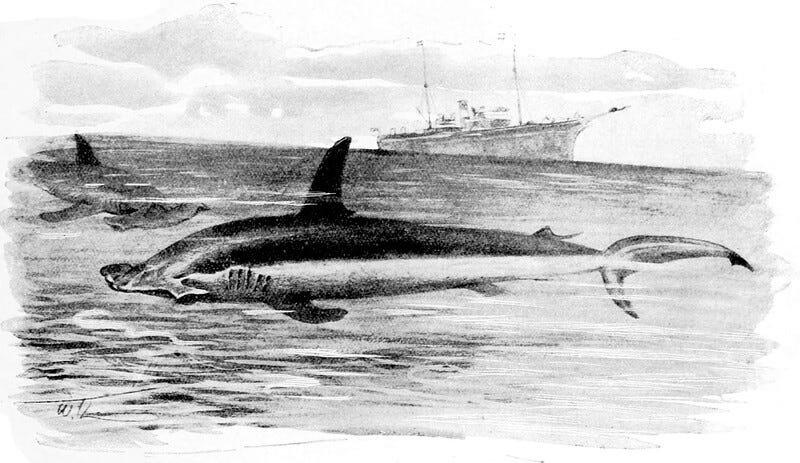
Every foot of the shark’s gaunt, stripped body was built for speed. There was not a bone anywhere under his drab and livid skin—only rings and strips and columns of tough, springy cartilage, which enabled him to cut through the water like a blade of tempered gray steel. With the rush of a torpedo the grim figure shot after the fleeing otter, who had but one advantage, and that was in length. It takes a six-foot body less time to turn than one that measures fifteen feet. In a straightaway race, the fish would have overtaken the mammal in a few seconds, but when it came to twisting, turning, and doubling, the sea otter had an advantage, albeit of the slightest.
Again and again the desperate sea mother avoided death by an inch. More than once the ringing jaws of the great fish snapped together just behind her, and only the tiny tick of time which it took to turn over saved her. Desperately she sought to win the refuge of the kelp-bed, but always the gray shape thrust itself between her and safety.
At last an ally of the sea folk joined in the hunt. Water was claiming her toll of oxygen from the alien within her depths. A sea otter can stay under for half an hour at a pinch—but not when swimming at full speed, with the laboring heart pumping blood at capacity, and this one realized despairingly that soon she must breathe or die. Little by little she shaped her course toward the surface, dreadfully fearing lest the second she must spend in drawing one deep breath would be her last. She flashed upward through a whole gamut of greens—chrome, cedar, jasper, myrtle, malachite, emerald—ending with the pulsing, golden sap-green of the surface. Swim as she would, however, the monstrous head was always just at her flank, and the slightest pause would give those fatal teeth their grip. Once again she avoided by a hair’s breadth a snap of the deadly jaws and struggled despairingly toward the upper air.
As the great fish turned to follow, out from the sunlight, through the gleaming water, shot a long, dark body. Away from the safety of the kelp to the head of horror with its implacable eyes came the old dog otter, for the creed of the sea otter is unchanging—one mate for life and death. With his round misshapen head bristling and his snaky black eyes gleaming like fire, this one crossed the vast back of the shark like a shadow. As the great fish turned to follow the fleeing mother, the blunt pebble-teeth of the dog otter, which can grind the flintiest shells to powder, fastened themselves with a bulldog grip just behind the last fin of the shark, where its long, sinuous tail joined the body. With all the force of his tremendous jaws, the great sea otter clamped his teeth through the masses of muscles, deep into the cartilage column, crushing one of its ball-and-socket joints.
Like a steel spring, the shark bent almost double on itself. Just as the gaping jaws were about to close, with a quick flirt of his body the otter swung across to the other side without relaxing for an instant the grip of those punishing teeth. The undershot jaws of the great fish could not reach the head of its tormentor, fixed as it was in the central ridge of the shark’s back. Again and again the hammerhead bent from side to side, but each time the old dog otter evaded the clashing teeth and ground to bits joint after joint of the shark’s spine, while the lashing tail-strokes became feebler and feebler.
Not until the mother otter and her cub were safe on their way to the kelp-bed, breathing great life-saving drafts of fresh air at the surface, did the grim jaws of the old otter relax. Then, with an arrowy dive and double, he shot under and over the disabled fish and sped away to join his mate in the hidden thickets of the kelp.
The swift Arctic summer soon passed, to be followed by the freezing gales of an Arctic winter. With the storms would come an enemy from the land, fiercer and more fatal than any foe that menaced the otter family by sea or sky, for these sea otter were among the last of their race, and there was a price upon their pelts beyond the dreams of the avarice of a thousand murky Aleuts and oily Kolash and Kodiakers, to say nothing of a horde of white adventurers from all the five continents of Earth. Only in storms, when the kelp-beds are broken, and the otters are forced to seek the shelter of beaches and sea caves, do hunters still have a chance to secure these rarest of all the fur-bearers.
At last came the first of the great winter gales. Day after day the wind howled up from the southeast, the storm quarter of that coast, and the air throbbed with the boom of breakers, while all the way down the Straits the whitecaps foamed and roared among a tangle of cross-currents.
The End, Part Three