
The Sea Otter 4/4
The final part of the thirtieth tale from The Animal Book
Out at sea, the great kelp-raft on which the otter family had lived since spring was at last broken and scattered under the pounding of the gale. Otters need sleep as much as humans and like them must sleep where they can breathe. Battered and blinded by the gale, the little family started to hunt for some refuge where they might slumber out the storm. Along all the miles of coast, and among the myriads of barren islands, there seemed to be no place where they could find a yard of safety. At the first sign of bad weather every strip of beach was patrolled and every islet guarded.
To lonely little Saanak the dog otter first led them, hoping to find some tiny stretch of safe beach among the water-worn boulders piled high along the shore. A mile to windward he stopped, thrust his blunt muzzle high up into the gale, and winnowed the salt-laden air through the meshes of his wonderful nostrils. Then he turned away at right angles, toward another island. A little band of Indian hunters, starved with cold, had built far back among the rocks a tiny fire.
Smoke spells death to a sea otter. Beyond Saanak the wary veteran visited other beaches, only to detect the death-scent of human footprints, although they had been washed by waves and covered by tides. In faraway Oonalaska, he sought the entrance of a sea cave in whose winding depths, many years before, he had found refuge. As he thrust his head into the hidden opening, his sturdy breast struck the strands of a net made of sea-lion sinews, so soaked and bleached by salt water that it bore even to his matchless nostrils no smell of danger. With a warning chirp, he halted his mate following close behind and backed out carefully without entangling himself among the wide meshes.
Agonizing for sleep, the little band turned back and journeyed wearily to the faraway islet of Attoo, the westernmost point of land in North America. In its lee was a sheltered kelp-raft never broken by the waves, although too near shore to be a safe refuge except in a storm. There, in the very center of the heaving bed, with the waves booming outside, the otter family slept the sleep of utter exhaustion, their heads buried under the kelp-stems and their shimmering bodies showing on the surface.
At the foot of a high bluff on Kodiak Island crouched Dick Barrington, on his first otter hunt. Dick was the son of a factor of the Hudson Bay Company, which, in spite of kings and parliaments, still rules Arctic America. With him as a guide was Oonga, the chief of a tribe of Aleutian hunters.
“Stick to old Oonga,” the factor had advised. “He knows more about sea otters than any man in his tribe. At that there’s only one chance in a thousand that you’ll get one.”
The old chief had allowed the rest of the band to slip away one by one, each choosing the islet or bit of shore where he hoped to draw the winning number in this lottery of the sea. Hour after hour went by, and still the old man sat huddled under the lee of the cliff. At last, he suddenly stood up. Although the gale seemed still at its height, his practiced eye saw signs that it was about to break, and in a moment, with Dick’s help, he had launched the triple-pointed, high-sterned bidarka, a little craft made of oiled sea-lion skins, as unsinkable as any boat could be.
A few quick strokes of the paddle and they were beyond the breakers. Then, straight across the bay, through the rush and smother of the storm, they shot toward Attoo. Steering by unknown ranges and glimpses of dim islands, old Oonga held his course unfalteringly until, just as the gale began to slacken, they reached the kelp-bed in the lee of the little island. Across the hollow tendrils the old chief guided the bidarka silently, in a zigzag course. Suddenly he stretched out his paddle and, touching Dick on the shoulder, pointed to a dark spot showing against the kelp a hundred yards away.
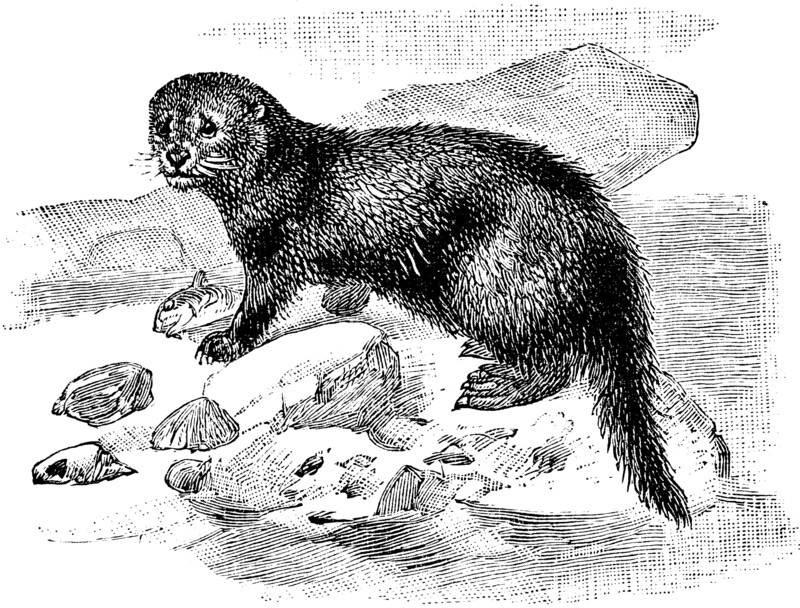
With infinite care the two edged the canoe along, until there before them lay asleep the mother otter, her cub clasped tight in her arms. Even as they watched, the little otter nuzzled its small white nose against its mother’s warm breast. As she felt its touch, without opening her eyes she clasped the cub tighter in her arms with a curiously human gesture and wrapped it close in her long silky fur, which had a changing shimmer and ripple through it like watered silk—a pelt with which a man might ransom his life.
As Dick gripped the short heavy club which the old chief had placed at his feet at the beginning of the voyage and looked down upon the pair, it seemed to him as if the great sea had taken him into her confidence and entrusted the sleeping mother and child to him. Suddenly, in the silence, with sea and sky watching, he knew that he could no more strike down that mother sleeping before him with her dear-loved cub in her arms than he could have killed a human child entrusted to his care.
With a quick motion, he splashed the water over the sleeping otter with the end of his club. So swiftly that the eye could scarcely follow her motion, the great otter flashed out of sight under the kelp, with her cub still held close. Once again, mother-love had been too strong for death.
The End